
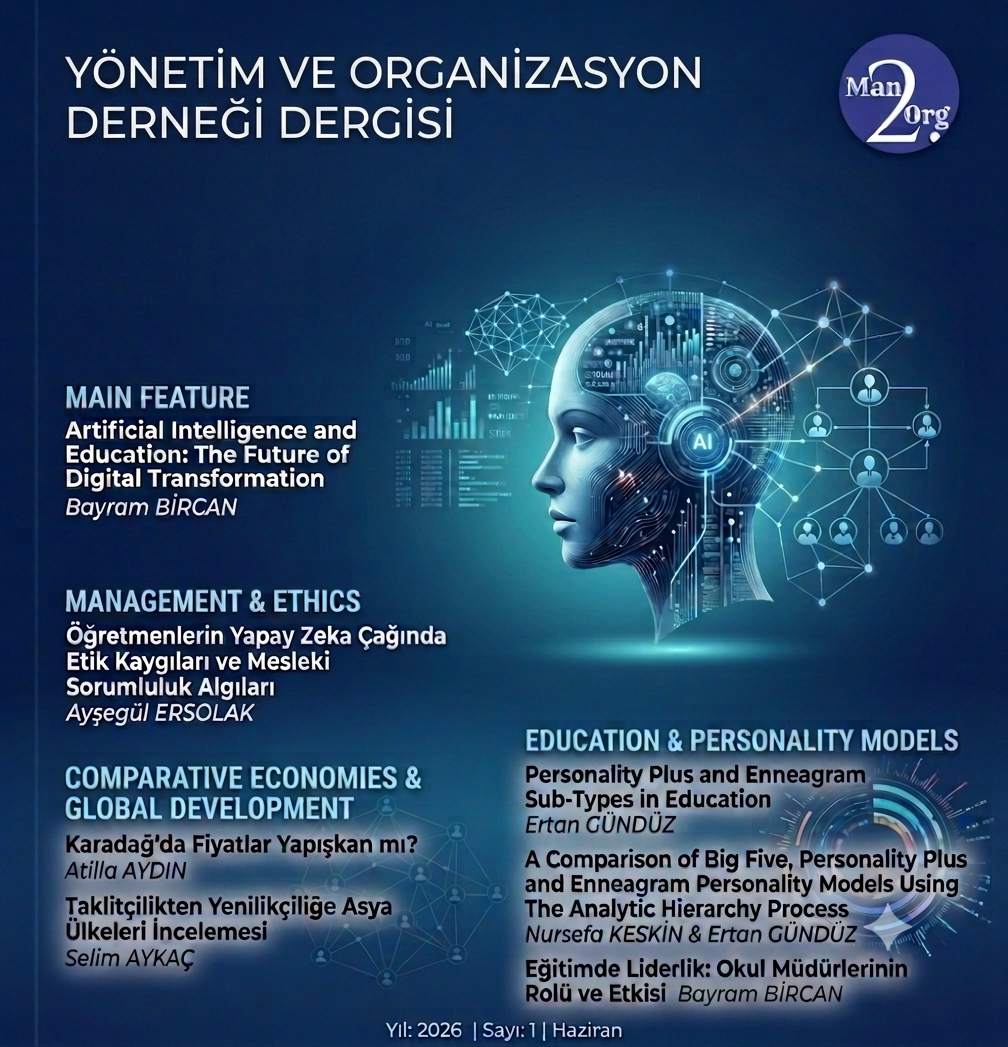
Artificial Intelligence and Education: The Future of Digital Transformation
Keywords:
artificial intelligence, educational technologies, digital transformation, learning analytics, educational policiesAbstract
In recent years, artificial intelligence (AI) has become one of the most significant technologies with the potential to transform educational systems. AI-supported systems provide new opportunities in education by making learning processes more personalized, efficient and accessible. This study aims to examine the integration of artificial intelligence into educational systems, its areas of application, advantages, challenges and possible future directions.
The study was conducted using the literature review method. Academic studies, reports and scientific publications focusing on the relationship between artificial intelligence and education were analyzed. Within the scope of the review, AI-based learning systems, intelligent tutoring assistants, assessment and evaluation tools, language learning platforms and applications designed for individuals with special needs were examined.
The findings indicate that artificial intelligence supports student-centered learning, reduces teachers’ workload and increases the efficiency of educational processes. However, important risks such as data privacy concerns, ethical issues, changes in teachers’ roles and inequalities in access to technology were also identified. As a result, it is concluded that in order to use artificial intelligence effectively and sustainably in education, policies should be developed in line with ethical principles, teacher training should be expanded and technological infrastructure should be strengthened.
References
Baker, T., & Smith, L. (2019). Artificial intelligence in education: Promises and implications for teaching and learning.
Duolingo AI. (2021). How AI is transforming language learning.
Huang, W., Zou, D., & Cheng, G. (2020). AI-driven learning analytics: A systematic review.
Keller, F. (2020). Adaptive learning and AI in modern education systems.
Luckin, R., Holmes, W., Griffiths, M., & Forcier, L. B. (2016). Intelligence unleashed: An argument for AI in education.
Reich, J. (2020). Inequity and access in AI-driven learning environments.
Selwyn, N. (2019). Should robots replace teachers? AI and the future of education.
Woolf, B. P. (2018). AI in education: A guide to intelligent systems in learning.
Downloads
Published
How to Cite
Issue
Section
License
Copyright (c) 2026 Journal of Management Organization Association

This work is licensed under a Creative Commons Attribution-NonCommercial 4.0 International License.


