
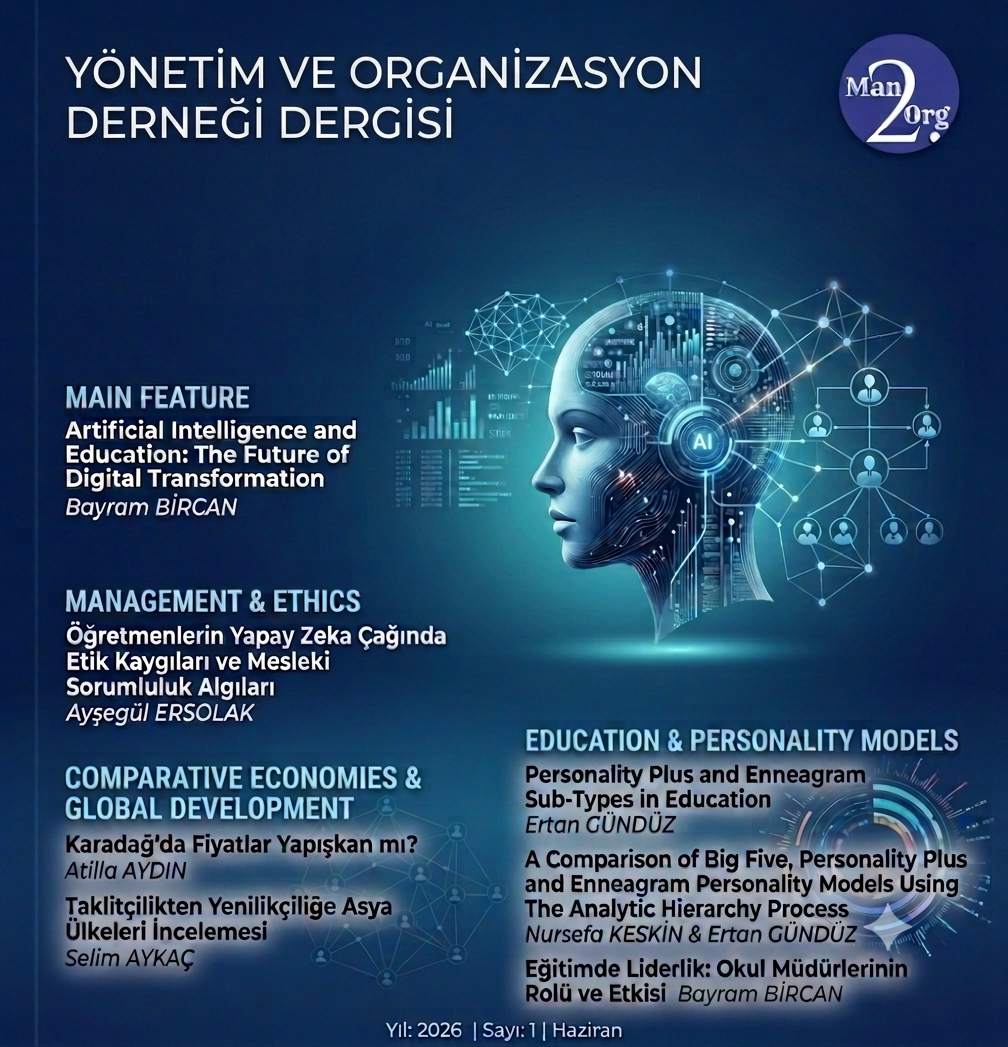
Öğretmenlerin Yapay Zeka Çağında Etik Kaygıları ve Mesleki Sorumluluk Algıları
Anahtar Kelimeler:
Yapay Zekâ Etiği, öğretmen sorumluluğu, veri mahremiyeti, algoritmik adalet, mesleki özerklikÖzet
Bu çalışmanın amacı, yapay zekâ (YZ) teknolojilerinin eğitim ortamlarına entegrasyonu sürecinde öğretmenlerin karşılaştıkları etik kaygıları ve mesleki sorumluluk algılarını bütüncül bir yaklaşımla incelemektir. Eğitimde dijital dönüşümün hız kazandığı günümüzde, öğretmenlerin yalnızca teknik yeterliklerinin değil; veri mahremiyeti, algoritmik adalet ve mesleki özerklik bağlamındaki deneyimlerinin de anlaşılması hedeflenmiştir. Araştırma, nitel araştırma yöntemine göre tasarlanmış ve olgu bilim (fenomenoloji) deseni benimsenmiştir. Çalışma grubu, amaçlı örnekleme yöntemlerinden ölçüt örnekleme kullanılarak belirlenen ve farklı branşlarda görev yapan 10 öğretmenden oluşmaktadır. Veriler, araştırmacı tarafından geliştirilen yarı yapılandırılmış görüşme formu aracılığıyla toplanmış ve içerik analizi tekniği ile analiz edilmiştir. Araştırma bulgularına göre, öğretmenler yapay zekâ araçlarını mesleği tehdit eden bir unsurdan ziyade zaman kazandıran güçlü bir asistan olarak görmektedir. Ancak bu iyimser yaklaşıma rağmen, öğretmenlerin en büyük kaygısının öğrencilerin veri mahremiyeti ve gözetim (dijital panoptikon) olduğu tespit edilmiştir. Ayrıca katılımcılar, yapay zekâ algoritmalarının tarihsel ve toplumsal önyargıları barındırabileceği, bu durumun da eğitimde fırsat eşitliğini zedeleyerek adalet sorunlarına yol açabileceği konusunda güçlü bir farkındalığa sahiptir. Mevcut yapay zekâ sistemlerinin karar alma süreçlerindeki şeffaflık eksikliği (kara kutu sorunu), öğretmenlerin sisteme güven duymasını ve hesap verebilirliklerini zorlaştırmaktadır. Çalışmanın sonucunda, öğretmenlik mesleğinin bilgi aktarıcılığından öğrenme sürecini tasarlayan ve yapay zekâ çıktılarını denetleyen bir etik bekçiliği (gatekeeper) ile dijital mentorluk rolüne evrildiği görülmüştür. Öğretmenler, nihai kararın ve sorumluluğun insan denetiminde kalması gerektiğini savunmakta; ancak mevcut hizmet içi eğitimlerin etik ve pedagojik boyutları kapsamada yetersiz kaldığını belirtmektedir.
Referanslar
Akgun, S. ve Greenhow, C. (2021). Artificial intelligence in education: Addressing ethical challenges in K-12 settings. AI and Ethics, 2, 431–440.
https://doi.org/10.1007/s43681-021-00049-4
Aydın, İ. (2016). Eğitim ve öğretim etiği. Pegem Akademi.
Baker, R. S. ve Hawn, A. (2021). Algorithmic bias in education. International Journal of Artificial Intelligence in Education, 32, 1052–1092.
https://doi.org/10.1007/s40593-021-00268-5
Banks, J. A. (2009). The Routledge international companion to multicultural education. Routledge.
Biesta, G. (2015). The beautiful risk of education. Paradigm Publishers.
Biesta, G. (2017). The rediscovery of teaching. Routledge.
Bozkurt, A. (2023). ChatGPT, üretken yapay zekâ ve algoritmik paradigma değişikliği. Açıköğretim Uygulamaları ve Araştırmaları Dergisi, 9(1), 7–17.
Campbell, E. (2003). The ethical teacher. Open University Press.
Coe, R. (2020). The role of evidence in teaching and learning. İçinde The guide to evidence-based teaching. Catapult.
Dignum, V. (2019). Responsible artificial intelligence: How to develop and use AI in a responsible way. Springer. https://doi.org/10.1007/978-3-030-30371-6
European Commission. (2019). Ethics guidelines for trustworthy AI. High-Level Expert Group on Artificial Intelligence.
Fischman, G. E., DiBello, L. ve Gardner, H. (2006). The challenges and potential of Internet-based interactions for social responsibility. The Journal of Aesthetic Education, 40(2), 39–51.
Floridi, L., Cowls, J., Beltrametti, M., Chatila, R., Chazerand, P., Dignum, V. ve Vayena, E. (2018). AI4People—An ethical framework for a good AI society: Opportunities, risks, principles, and recommendations. Minds and Machines, 28(4), 689–707. https://doi.org/10.1007/s11023-018-9482-5
Ho, A. D. ve diğerleri (2017). Big data analysis for MOOCs. University of Pennsylvania Press.
Holmes, W., Bialik, M. ve Fadel, C. (2019). Artificial intelligence in education: Promises and implications for teaching and learning. Center for Curriculum Redesign.
Holstein, K., McLaren, B. M. ve Aleven, V. (2019). Co-designing a real-time classroom orchestration tool to support teacher–AI complementarity. Journal of Learning Analytics, 6(2), 27–52. https://doi.org/10.18608/jla.2019.62.3
Jobin, A., Ienca, M. ve Vayena, E. (2019). The global landscape of AI ethics guidelines. Nature Machine Intelligence, 1(9), 389–399.
https://doi.org/10.1038/s42256-019-0088-2
Jonas, H. (1984). The imperative of responsibility: In search of an ethics for the technological age. University of Chicago Press.
Kizilcec, R. F., Pérez-Sanagustín, M., Maldonado, J. J., & Morales, N. (2017). Closing the loop: Teacher and student trust in an adaptive educational technology. İçinde Proceedings of the Fourth (2017) ACM Conference on Learning @ Scale. https://doi.org/10.1145/3051457.3051463
Knox, J. (2020). Artificial intelligence and the end of the human: The “post-humanist” displacement of the teacher. Postdigital Science and Education, 2(3), 674–688.
https://doi.org/10.1007/s42438-020-00120-3
Lauermann, F. ve Karabenick, S. A. (2013). The meaning and measure of teachers’ sense of responsibility for educational outcomes. Teaching and Teacher Education, 30, 13–26. https://doi.org/10.1016/j.tate.2012.10.001
Long, D. ve Magerko, B. (2020). What is AI literacy? Competencies and design considerations. İçinde Proceedings of the 2020 CHI Conference on Human Factors in Computing Systems.
https://doi.org/10.1145/3313831.3376727
Lupton, D. ve Williamson, B. (2017). The datafied child: The dataveillance of children and implications for their rights. New Media ve Society, 19(5), 780–794.
https://doi.org/10.1177/1461444816686328
Mehrabi, N., Morstatter, F., Saxena, N., Lerman, K. ve Galstyan, A. (2021). A survey on bias and fairness in machine learning. ACM Computing Surveys (CSUR), 54(6), 1–35. https://doi.org/10.1145/3457607
Milli Eğitim Bakanlığı. (2015). Öğretmenlik mesleği genel yeterlikleri. Öğretmen Yetiştirme ve Geliştirme Genel Müdürlüğü.
Müller, V. C. (2020). Ethics of artificial intelligence and robotics. Stanford Encyclopedia of Philosophy.
OECD. (2020). Back to the future of education: Four OECD scenarios for schooling. OECD Publishing. https://doi.org/10.1787/178ef527-en
Pasquale, F. (2015). The black box society: The secret algorithms that control money and information. Harvard University Press.
Reich, J. (2020). Failure to disrupt: Why technology alone can’t transform education. Harvard University Press.
Santoro, D. A. (2011). Good teaching in difficult times: Demoralization in the pursuit of good work. American Journal of Education, 118(1), 1–23.
Selwyn, N. (2019). Should robots replace teachers? AI and the future of education. Polity Press.
Slade, S. ve Prinsloo, P. (2013). Learning analytics: Ethical issues and dilemmas. American Behavioral Scientist, 57(10), 1510–1529.
https://doi.org/10.1177/0002764213479366
Solbrekke, T. D. ve Englund, T. (2011). Bringing professional responsibility back in. Studies in Higher Education, 36(8), 847–861.
https://doi.org/10.1080/03075079.2010.482205
UNESCO. (2021). AI and education: Guidance for policy-makers. UNESCO Publishing.
Zuboff, S. (2019). The age of surveillance capitalism: The fight for a human future at the new frontier of power. PublicAffairs.
İndir
Yayınlanmış
Nasıl Atıf Yapılır
Sayı
Bölüm
Lisans
Telif Hakkı (c) 2026 Yönetim Organizasyon Derneği Dergisi

Bu çalışma Creative Commons Attribution-NonCommercial 4.0 International License ile lisanslanmıştır.


